
Hydrogen sulfide (H2S) is a toxic and corrosive contaminant found in Natural Gas. Even at low parts per million (ppm) levels, H2S corrodes pipelines, processing equipment and storage infrastructure, leading to severe operational challenges and noncompliance with regulations. Precise concentration monitoring is therefore essential to safeguard personnel, prevent equipment degradation, and uphold product quality standards. As regulatory frameworks tighten and the push for cleaner energy intensifies, monitoring H2S levels has become critical to mitigating environmental risks, maintaining operational integrity, and strictly adhering to evolving safety protocols. However, the broad variability and compositional complexity of these gas matrices present a substantial challenge to reliably and selectively measuring H2S.
Advantages of TDLAS with a Multipass Cell
Pipeline tariffs in North America typically cap H2S at 4 ppm, and European grid specifications are similarly strict. Verifying compliance requires reliably measuring single-digit ppm of a gas whose composition changes from one delivery to the next. Tunable Diode Laser Absorption Spectroscopy (TDLAS) is capable of measuring H2S with the required sensitivity.
There are two things that make that difficult. First, H2S absorption is relatively weak. Second, hydrocarbons absorb in the same spectral region, which creates interference with the H2S absorption lines.
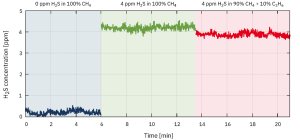
A Multipass cell helps to address both challenges. Folding the beam repeatedly between two spherical mirrors extends the optical path to tens of meters inside a compact housing, and absorbance scales with path length. The improved signal-to-noise ratio also makes the second challenge tractable. With sufficient signal, chemometric methods can be applied to distinguish the H2S line from the overlapping hydrocarbon contributions rather than averaging them. The figure below shows 4 ppm of H2S measured first in pure methane and then in a 90% CH4/10% C2H6 blend. The reading remains consistent despite the change in matrix.
Established alternatives each concede something at this level. Gas chromatography is accurate, but it requires sample preparation and provides results every few minutes rather than continuously. Lead-acetate tape analyzers consume a reagent on a fixed replacement schedule. Electrochemical cells are inexpensive, but they are cross-sensitive and age quickly, so the recalibration interval is short. In contrast, a TDLAS analyzer with a Multipass cell has no consumables or scrubbers. It holds its calibration for years and reports continuously, so excursions are visible as they happen rather than after the fact.
NEO Monitors’ solution
NEO Monitors is recognized as the leader and pioneer in TDLAS technology. With extensive experience in H2S spectroscopy, NEO Monitors optimizes analyzers for precision, reliability, and seamless integration into demanding industrial applications. The design and performance of the LaserGas™ II MP H2S extractive analyzer reflect a strong commitment to advancing H2S measurement technologies.
With excellent detection limits and high dynamic range, LaserGas™ II MP is the ideal choice for measuring H2S in Natural Gas and other applications.
All LaserGas™ products offer:
- Sensitive and selective
- Fast response time
- No drift of zero/span
- Continuous health check monitoring
- Low maintenance requirements, no scrubbers
- High reliability and longevity
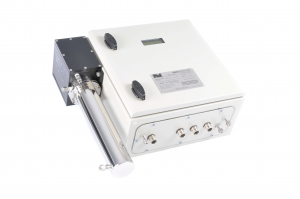
| Application | H2S in Natural Gas and other hydrocarbon mixtures |
| Typical range | 0 – 10, 0 – 20, 0 – 50, 0 – 100 ppm |
| Detection limit | < 1.0 ppm, typical 0.5 ppm |
| Typical precision | 0.2 ppm or 2 %rel |
| Cell pressure | 1.0 – 1.3 barA |
| Flow rate | 2.0 – 8.0 L/min |
| Response time (T90) | 10 s @ 5 L/min |
| Hazardous-area classification | IECEx/ATEX zone 2; CSA Class I Div 2 |
Installation recommendation
For optimal performance and reliability, it is recommended to install the LaserGas™ II MP H2S analyzer indoors or in a temperature-regulated shelter. The analyzer is equipped with built-in temperature and pressure sensors, such that there is no need to use external probes. The sampling system should include a particulate and oil filter and flow regulator to maintain the necessary flow rate.
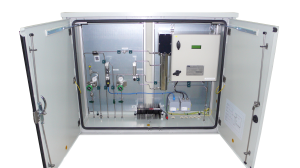
LaserGas™ II MP H2S analyzer implementation for measurements in natural gas, showing the Multipass cell, sample conditioning panel, and electronics housed within a weatherproof enclosure.
Application Note: Measuring H2S in Natural Gas using TDLAS with a Multipass Cell
-
See more
Product
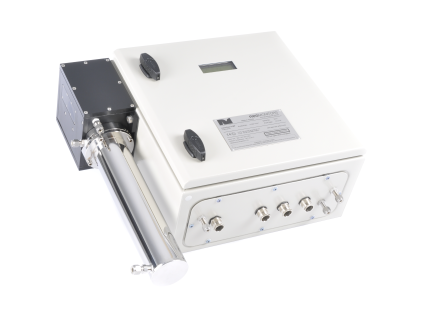
LaserGas™ II MP
See more- Very low detection limits
- Fast response time
- ATEX, IECEx, UKEx and CSA-certified
-
See more
Product
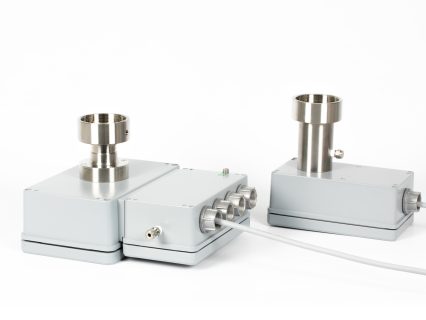
LaserGas™ II SP Compact
See more- Fast response time
- Wide variety of gases and applications
- Compact design, optimized for small pipe installation
-
See more
Product
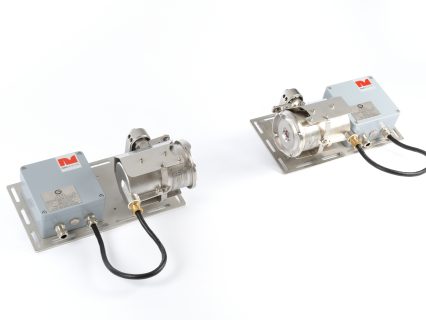
LaserGas™ III OP
See more- Fast response time
- Automatic health check
- Suitable for harsh environment